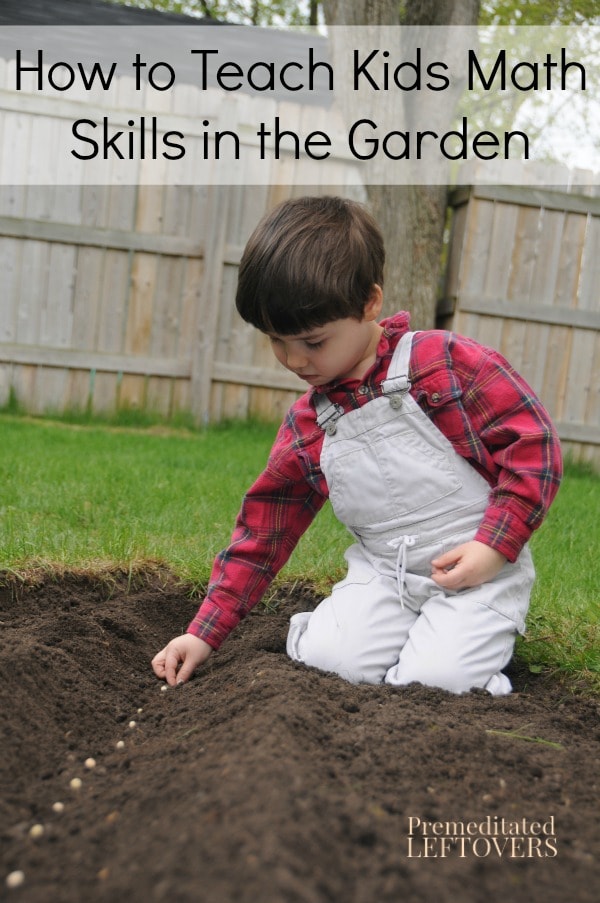
 Believe it or not, you can’t grow a garden without doing a little math. So before you start planting your garden for the season, grab the kids and see how many important math skills you can teach them in the process! If you aren’t sure about where to begin, take a peek below at how to teach kids math skills in the garden. You will find that turning the garden into your own math lab can be fun and easy.
How to Teach Kids Math Skills in the Garden
Before you begin, here are a few materials that may come in hand. Grab a pencil or pen, a spiral notebook, markers, poster board, a calculator, scale, and measuring tools such as a ruler, tape measure, and measuring cup.
1. Utilize math in your planning.
To plan a garden, you need to figure out how much space you are working with. Take your tape measure and measure the size of the land plot or planting box you are using. You will also need to see how much space each of your plants needs, so you can make sure you fill the space but don’t overcrowd your plants. When deciding how much mulch, soil, seed, and other supplies to buy, use math! While figuring these numbers out in your head is quick, actually taking the time to show your child how to find the answer is even better. Jot all of your estimations down in your journal.
2. Utilize math in your planting.
Once it is time to plant, you will want to have a ruler on hand. This will help you plant the seed the perfect depth as well as space the seeds out as directed. You can find all of the measurements on the back of the seed packet. Use your ruler to check seed depth as well as the space between seeds/seedlings. You can also use it to make sure your rows are spaced as needed. Write down any important measurements in your journal as well.
3. Utilize math in your maintenance.
Now it is time to maintain your plantings. You will want a ruler or rain gauge to check rainfall during the week. This will help you decide how much water your plants need. You will also need measuring cups to measure out any fertilizers or plant foods you will be using. Be sure your plants are getting the correct amount of sun each day as well, by counting the number of hours they sun hits them. You can record all of your measurements in a journal and even include sketches if you wish.
4. Measure your plants growth.
Use a ruler to measure the amount your plants grow each week. You can track your findings on a piece of poster board or in your journals. You can find the measurement in both centimeters and inches. You can also weigh produce as you pick it, using a scale to check the weight in pounds and ounces.
5. Use math to tally up your harvest.
It is fun to figure out how much your garden has produced over the season. Weigh produce and keep track of the amounts in your journal. This way at the end of the season you can say you grew X amount of pounds in your garden and aim to meet it or beat it next season!
See how fun it can be to teach important math skills in your own garden? Give these suggestions a try and see what a fantastic learning experience it can be.
More Educational Activities for Kids
Tips for Going on a Nature Walk with Kids
How to Teach Kids Science in the Garden
10 Children’s Books That Encourage Math Skills

Leave a Reply