Container gardens are not just for apartment dwellers! Even though I live on several acres and have a nice sized garden, I have a container garden. We have a short growing season, coupled with a 30 degree temperature swing every day. This means that spring and fall are pretty inhospitable to plants that like warm temperatures, particularly tomatoes, peppers, and eggplant. So at the end of the season when the nurseries start marking down their veggies, I pick up a few:
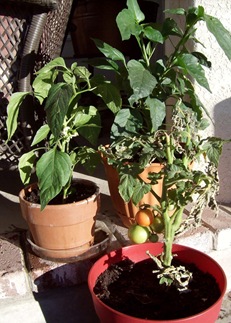 They look a little pathetic. Yes, I know, the tomato plant looks really pathetic. The plants were bone dry and shriveled when I bought them (The cashier looked at the plants and said, “well aren’t you a dear soul?” then looked at me like I was Mother Theresa. Or insane; it is hard to tell the two expressions apart). However, they are already showing signs of recovering with nutrient rich soil and water. The tomatoes are ripening and the plants are beginning to flower again:
 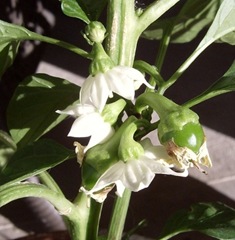 Once our evening temperatures start to dip into the 30’s, I bring the containers into the garage at night. I put them back out during the day, so they can benefit from the warm afternoon sun and increase their chances of being pollinated.
Things to consider when starting a container garden:
~ Pick the healthiest plants available. There is no reason to follow my example and rescue dying plants.
~ Look for varieties that remain fairly small. These words will often be included in their name: Compact, Space Saver, Patio, Bush. You can grow large varieties if you have large containers, they are harder to lug back and forth.
~ Select a container that will allow for root growth. I use a rule of thumb of picking a container that is at least twice the size of the plant’s root ball.
~ You will need something besides plain old dirt when potting these plants. I use a mix of 1 part compost to 2 parts commercially prepared potting mix, but any nutrient rich mix will work.
~ Ensure that your container has holes at the base to permit drainage. You can always create holes yourself by using a hammer and nail to create holes.
~ Container gardens need to be watered daily. If you are going to be away for a day or two, you will want to put the containers in a large tub with an inch of water in it or make arrangements for someone to water for you.
Container gardens are a little extra work, but eating fresh tomatoes and peppers while watching the snow fall makes it worth the effort!
Did I mentioned that I have a short growing season? What hurdles do you face when gardening?
This post has been linked to Bloomin’ Tuesday and Tuesday Garden Party.

Louis van der Ploeg says
Hi ,I am Louis for the Netherlands. I like your tips for the plants in pots.
I work as a volunteer on a care farm with people who have a mental disability. As head gardener, I like to experiment and because the garden is intended for day care of our clients, we grow almost all of our vegetables in pots. As a result, it is labour intensive but that is also the design of our garden and the work we do in it.
We also have a small greenhouse and in that we grow even bananas, pineapple, peppers and haricot kilometre ( Katjang Pandjang form indonesia) . Although the Dutch climate is totally unsuitable for it.
For people with a small greenhouse I have another tip for the heating in the winter time and early spring. Before I retired, I worked as a microbiologist and that knowledge I now use for heating our greenhouse. The key words for this are: Bacteria and a well-designed compost pile. The bacteria inside the compost pile produce heat (up to 70 degrees Celsius) at the conversion process. And that we use to heat our greenhouse to keep above freezing in the winter and in early spring the greenhouse on correct temperature. The compost pile is our free heat source. We do this by placing, water-filled tubes, without air, in the compost pile. The water movement as saying in hot water takes off. We are leading this warm water through the greenhouse and there it gives off it’s heat.
I hope this is a usefull tip for some of you.
Jami says
Well, I like to say I've no luck with planters, but it's more like you said- I never want to put in the extra work, so they don't do well. The comment of the cashier made me smile! Thanks for sharing at the Garden Party.
Melinda says
Bingo! That hint about adding the fertilizer was just the one I needed! I'm hitting myself over the head saying "Duh – why didn't I remember that!"
zentmrs says
Just about our entire garden is containerized (?) this year. We have our irrigation set up carefully because you are right – containers need daily watering! Thanks for the tips!
Jean says
Great tips for container gardens! I seem to have less and less containers because I hate to water them. A few of mine have already been hidden away. Jean
Becca's Dirt says
Good tips for containers. I use containers too. I bet that is a neat feeling to have a freshly grown tomato with snow on the ground. Good work on reviving the plants. You are a plant angel.
Darla says
I grow a lot of things in containers as well. My what strange weather you have. http://morefamilyandflowers-darla.blogspot.com
Racquel says
I've experimented with growing several things in containers (large & small). Lettuce,Cukes, Squash, Tomatoes, Peppers etc… Some have been quite successful and some weren't. It's fun though to try. Good luck! 🙂