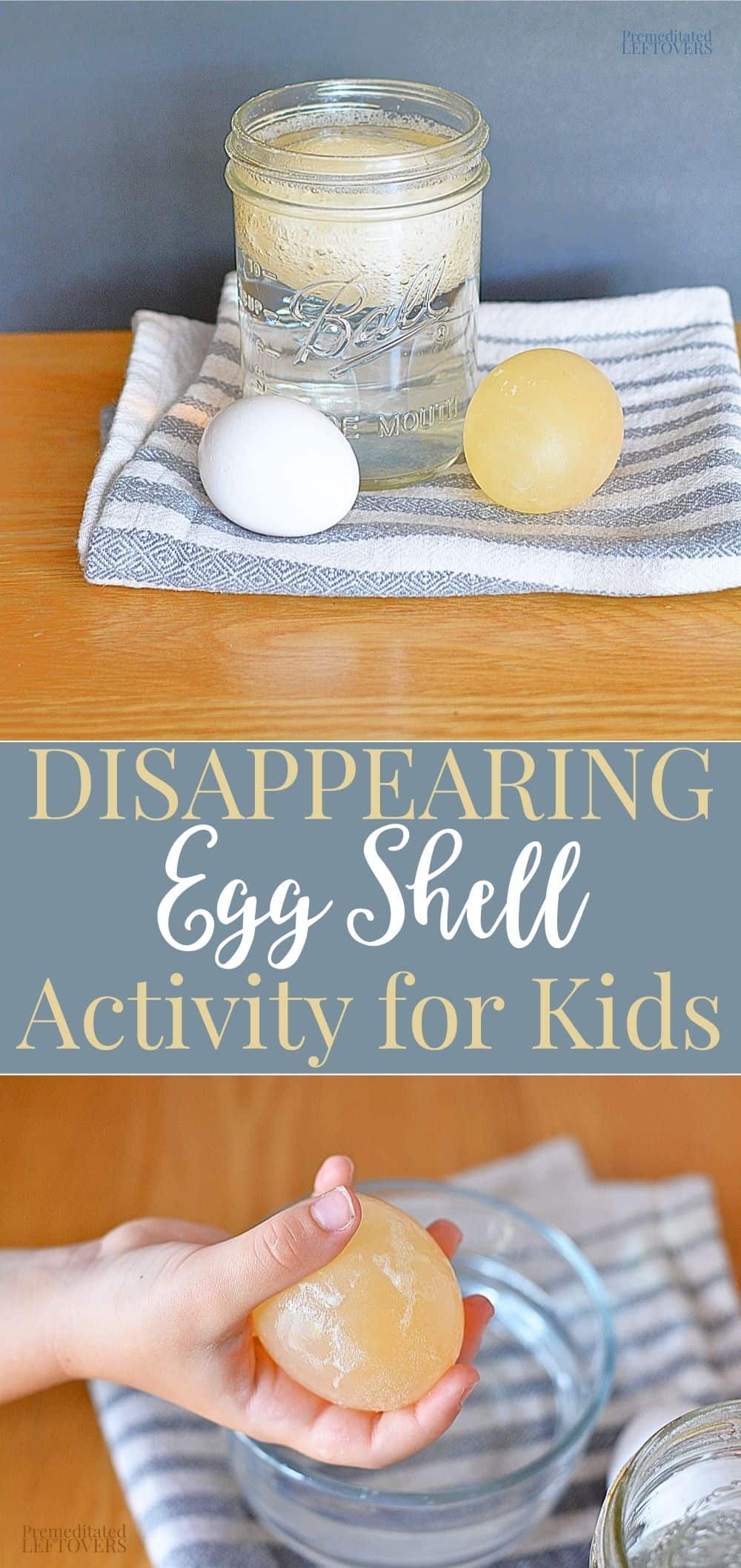
Here is a fun and educational disappearing eggshell activity for kids!

This egg experiment is a great letter “E” activity for preschoolers and a fun science activity for older kids! If you are using this Disappearing Egg Shell Activity for Kids with older elementary kids, below is some background.
How to Make an Eggshell Disappear
The eggshell dissolves because eggshells contain calcium carbonate, the main ingredient in many antacid tablets. This dissolves in the acidic vinegar to produce calcium ions (which stay dissolved in the vinegar) and carbon dioxide gas. The carbon dioxide produces the bubbles that you will see while the egg is dissolving. Now that you know the science behind this cool activity, below is everything your kids need to give this fun science experiment a try!
An analogy many of us live with on the East Coast, especially Florida: calcium carbonate is the main compound in limestone. Limestone is a common rock type on the East Coast, and it is pretty much the rock type the Florida peninsula is composed of. Rain water is naturally a little acidic – not as much as vinegar, but it’s weakly acidic nonetheless. So it slowly dissolves limestone. Two natural phenomena result from this: 1) limestone caves with spectacular stalagmites and stalactites, and 2) sinkholes! Sinkholes result when a rain water dissolves a large unseen void in limestone…that eventually collapses.
Disappearing Eggshell Activity for Kids
Supplies:
- 16-ounce mason jar with lid and ring
- white vinegar
- fresh egg
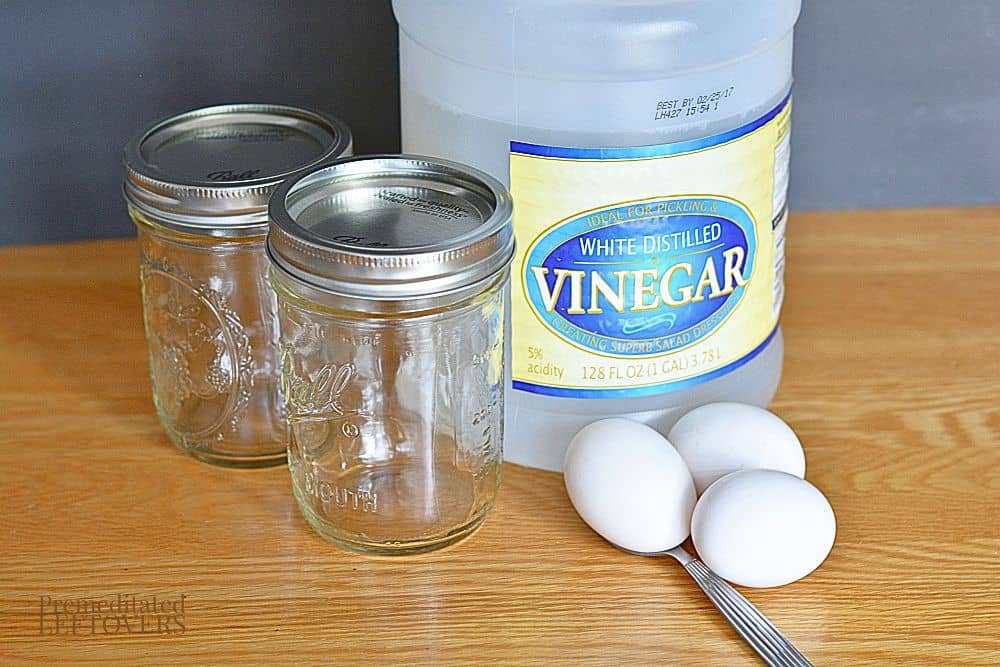
Directions:
1. Gently place the egg into the mason jar.
2. Fill with vinegar leaving 1/2″ space at the top. It is important to leave room at the top of the jar or it might burst from the carbon dioxide gas produced by the reaction.
3. Loosely cover the jar with the lid and ring. Again, make sure it is not too tight so that the gas can escape the jar.
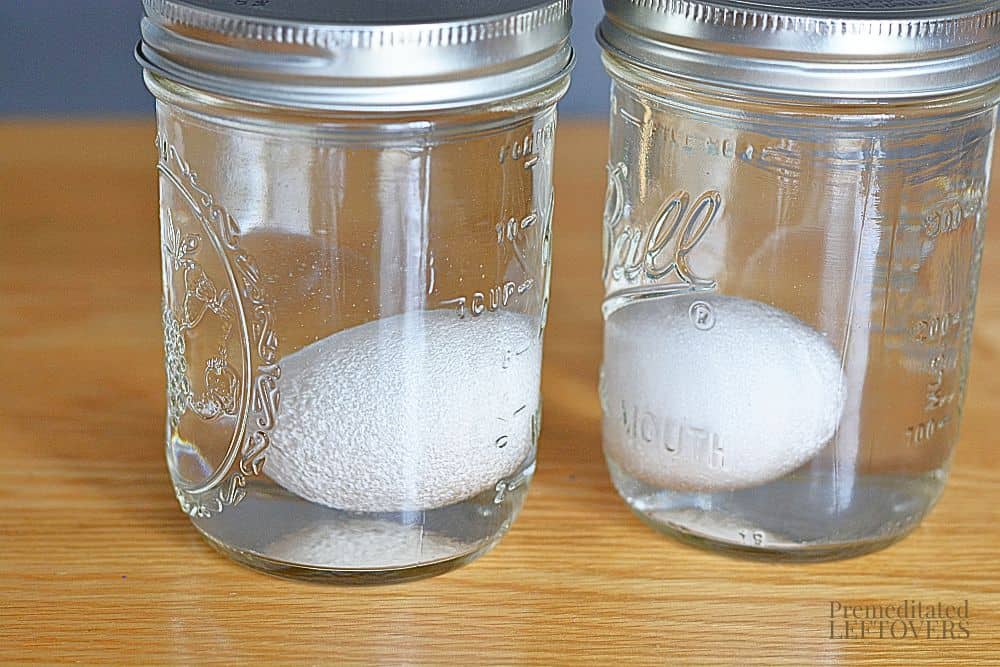
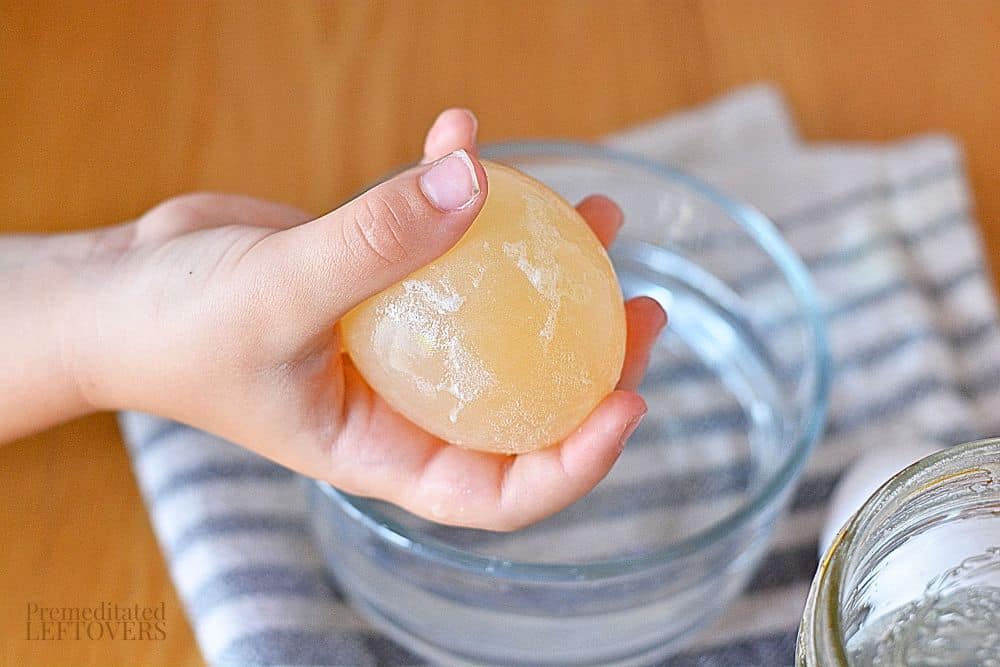
4. Let sit for about two days. Remove from jar and rinse off in water. Enjoy your shell-less egg!
Printable Instructions for the Disappearing Egg Shell Experiment
Disappearing Eggshell Experiment for Kids
Ingredients
Supplies:
- 16- ounce mason jar with lid and ring
- white vinegar
- fresh egg
Instructions
Instructions:
- Gently place the egg into the mason jar.
- Fill with vinegar leaving 1/2" space at the top. It is important to leave room at the top of the jar or it might burst from the carbon dioxide gas produced by the reaction.
- Loosely cover the jar with the lid and ring. Again, make sure it is not too tight so that the gas can escape the jar.
- Let sit for about two days. Remove from jar and rinse off in water. Enjoy your shell-less egg!
More Fun Activities for Kids:
Bouncing Beans Activity for Kids
Egg Carton Caterpillar Craft for Kids
Popsicle Stick Dragonfly Craft
Alphabet Activity Jar and 5 Alphabet Activities
10 Quick and Easy Phonics Activities
Thanks to Kari of Craft Create Cook for sharing her tutorial and pictures with us.

Kim Stowe says
Can this egg be eaten?
Alea Milham says
No, I wouldn’t eat this egg.
Margo Clark says
Can this be done without a lid?
Reka Keller says
Can I use anything other than white vinegar?
Rebbecca Devitt says
Wow, really cool trick to try.
Lyd says
Can I bounce them
Savanna says
I use this demonstration as a Dental Hygienist. However I use Mt. Dew, Sprite, Cola etc…. however……. I boil the eggs first…. I have not tried this way uncooked before…. seems like an unwanted mess for me! Lol 😉
Sarah says
Thank you for sharing this idea!! I have 2 toddlers and a 10-year-old that I think will like this. We’re going to try it out this weekend!
Stephanie says
You can also do this with a hard boiled egg for kids who are a little rougher. You will still have the same results except the egg won’t pop or break do to it being boiled
Tia says
Does it matter on the size of jar? Could I use bigger but just add 16oz of vinegar?
Lakshmi says
can i do this for my preschool class?
Alea Milham says
Yes, you can.
Joan v Tonder says
How long do this experiment take?
Laura says
Are the eggs edible?
Alea Milham says
We have never tried.
Ms. K says
– It’s better to use older eggs, rather than “fresh” eggs.
When I do this for the classroom, I buy several cartons of eggs and I search for the ones with the oldest date. I also buy them 2 weeks in advance if I can. The older eggs have a more durable membrane and are less likely to pop when being roughly handled. Especially when kids like to rub any loose extra shell off or when they like to “dry” the egg and get too rough. It’s a significant difference if you do the standard experiment that goes with this (see below). But you won’t get too many popped eggs if you only do these steps and the kids are gentle.
– Adding food color to the vinegar will dye the membrane (just for fun).
However, it’s neater to see an uncolored one, as you can usually make out the yolk inside if you have enough light to see by. Brighter colors like yellow, orange, and red look best.
– You can tell your kids that what they are holding is literally one giant cell. Yes, as in those microscopic biology cells that make up all living things. Eggs are very large cells in general, and bird eggs are one GIANT cell with an extra thick outer membrane (that’s why it doesn’t pop once the shell is gone). Normally a cell that big would have trouble surviving, but an egg cell is a special case. It’s basically dormant, or ‘sleeping’, and all the important cellular stuff is clumped into one tiny area (you can’t see it).
– In case anyone is wondering, this is done in Biology classes as a diffusion experiment or demonstration.
AFTER these steps shown here – the egg is patted dry and weighed. Then, it is put into different solutions (and re-weighed each time) to show the change in mass. Water diffuses into or out of the egg based on what you let it soak in. The standard is to at least let it soak 24 hours in plain water (water goes in egg, egg gets bigger) and let it soak 24 hours in some highly concentrated solution like cheap Karo syrup or cheap maple syrup (water leaves egg, egg gets smaller and shriveled). Karo is better for classrooms because maple syrup smells good and the kids are VERY tempted to eat it. I guarantee you that at least one kid will eat some when you’re not looking, no matter how much you try to gross them out about it before-hand. If you search for something like “egg diffusion lab” or words like “egg, osmosis, diffusion, semi-permeable, lab, demo” you might find something for little kids. I used this lab for 9th graders, and some teachers use it in middle school.
– Also, while I’m writing much more than I intended… I should mention something. The eggs you get from the grocery store will never be a chicken. Not even if they had stayed with the hen. Those stories of cracking open an egg and occasionally getting a partial chick inside from your grandparents are from the olden days of local farm eggs. Modern grocery eggs are from chickens that never see a rooster – thus the eggs they make are just a cell of themself getting released. Farm eggs, however, well – life on the farm can involve roosters and sometimes those roosters get in with the hens and the magic of babies happens. Then the hen can lay an egg that contains a new life, and you might end up with one of “those” eggs. So just stick with the regular eggs from the regular grocery store for classroom use.
Cristy says
Thank you for this explanation.
jo says
I can’t thank you enough for all the explanation. I am a science teacher but lack science knowledge. thank goodness i stick to elementary level. nonetheless, i needed the lesson to help out my little guys!
Anna says
Wow! Cool. I can’t wait to try this with my preschool class. Start with a raw egg?
Alea Milham says
Yes, you start with a raw egg.